From Labs to Devices: AI and Agents Become Operational Priorities
Published Jan 4, 2026
Worried your AI pilots stall at deployment? In the past 14 days major vendors pushed capabilities that make operationalization the real battleground — here’s what to know for your roadmap. Big labs shipped on-device multimodal tools (xAI’s Grok-2-mini, API live 2025-12-23; Apple’s MLX quantization updates 2025-12-27), agent frameworks added observability and policy (Microsoft Azure AI Agents preview 2025-12-20; LangGraph RC 1.0 on 2025-12-30), and infra vendors published runbooks (HashiCorp refs 2025-12-19; Datadog LLM Observability GA 2025-12-27). Quantum roadmaps emphasize logical qubits (IBM target: 100+ logical qubits by 2029; Quantinuum reports logical error 50% on 2025-12-22; Beam showed >70% in-vivo editing on 2025-12-19; Nasdaq piloted LLM triage reducing false positives 20–30% on 2025-12-21). Bottom line: focus less on raw model quality and more on SDK/hardware integration, SRE/DevOps, observability, and governance to actually deploy value.

AI Goes Operational: Agentic Coding, On-Device Models, Drug Discovery
Published Jan 4, 2026
55% faster coding? That's the shake-up: in late Dec 2025–early Jan 2026 vendors moved AI from demos into production workflows, and you need to know what to act on. GitHub (2025-12-23) rolled Copilot for Azure/Microsoft 365 and started Copilot Workspace private previews in the last 14 days for “issue‐to‐PR” agentic flows; Microsoft reports 55% faster completion for some tasks. Edge vendors showed concrete on-device wins—Qualcomm cites up to 45 TOPS for NPUs, community tests (2025-12-25–2026-01-04) ran Llama 3.2 3B/8B with 2,000 AI‐designed compounds; healthcare and vendors report >90% metrics and scribes saving 5–7 minutes per visit. Exchanges process billions of messages daily; quantum and security updates emphasize logical qubits and memory-safe language migrations. Bottom line: shift from “can it?” to “how do we integrate, govern, and observe it?”

From Demos to Workflow OS: How AI Is Rewriting Enterprise Infrastructure
Published Jan 4, 2026
Still wrestling with flaky AI pilots and surprise production incidents? This brief shows what changed, who moved when, and what you should do next. Late‐Dec 2024–early‐2025 saw LLMs shift from one‐off calls to orchestracted agent workflows in production—Salesforce (12/23, 12/27), HubSpot (12/22, 12/28), DoorDash (12/28) and Shopify (12/30) run agents over CRMs, ticketing and observability with human checkpoints. Platform teams centralized AI (Humanitec 12/22; CNCF 12/23; Backstage 12/27–12/28). Security and policy tightened: CISA urged memory‐safe languages (12/22) and SBOM work advanced (Linux Foundation/OpenSSF 1/02/25). Apple (12/23) and Qualcomm (12/30) pushed on‐device models. Observability vendors (Datadog 12/20; Arize 1/02/25) tied LLM traces to OpenTelemetry. Immediate takeaway: treat agents as platform products—standard APIs, identity, secrets, logging, and human gates before you scale.

From Demos to Production: AI Becomes Core Infrastructure Across Industries
Published Jan 4, 2026
Worried AI pilots will break your repo or your compliance? In the last two weeks (late Dec 2025–early Jan 2026) vendors pushed agentic, repo‐wide coding tools (GitHub Copilot Workspace, Sourcegraph Cody, Tabnine, JetBrains) into structured pilots; on‐device multimodal models hit practical latencies (Qualcomm, Apple, community toolchains); AI became treated as first‐class infra (Humanitec, Backstage plugins; Arize, LangSmith, W&B observability); quantum announcements emphasized logical qubits and error‐correction; pharma and protein teams reported end‐to‐end AI discovery pipelines; brokers tightened algorithmic trading guardrails; governments and OSS groups pushed memory‐safe languages and SBOMs; and creative suites integrated AI as assistive features with provenance. What to do now: pilot agents with strict review/audit, design hybrid on‐device/cloud flows, platformize AI telemetry and governance, adopt memory‐safe/supply‐chain controls, and track logical‐qubit roadmaps for timing.

From Chatbots to Agents: AI Becomes Infrastructure, Not Hype
Published Jan 4, 2026
Demos aren’t cutting it anymore—over the past two weeks vendors and labs moved AI from experiments into systems you can run. Here’s what you’ll get: concrete signals and dates showing the pivot to production. Replit open‐sourced an agentic coding environment on 2024‐12‐26; Databricks added “AI Tools” on 2024‐12‐27; Google and Meta published on‐device inference updates (12‐27 and 12‐30); Isomorphic Labs and Eli Lilly expanded collaboration on 12‐23 and a bioRxiv preprint (12‐28) showed closed‐loop AI‐driven wet labs; NIH and a JAMA study (late‐Dec 2024/12‐29) pushed workflow validation in healthcare; Nasdaq (12‐22) and BIS (12‐24) highlighted ML for surveillance; quantum roadmaps focus on logical qubits; platform teams and creative tools are integrating AI with observability and provenance. Bottom line: the leverage is in tracking how infrastructure, permissions, and observability reshape deployments and product risk.

AI Agents Embed Into Productivity Suites, Dev Tools, and Critical Systems
Published Jan 4, 2026
120 billion market events a day are now being scanned by AI — and in mid‐late December 2024 vendors moved these pilots into core platforms. Want the essentials? On 2024‐12‐17 Datadog launched Bits AI (GA) after >1,000 beta customers; on 2024‐12‐19 Atlassian expanded proactive agents in Jira and Confluence with “millions of AI actions per week”; Nasdaq’s SMARTS now applies ML to cross‐market surveillance; on 2024‐12‐20 Quantinuum reported two‐qubit gate fidelities above 99.8%; and on 2024‐12‐23 Insilico advanced an AI‐designed drug toward Phase II after ~2.5 years to Phase I. Why it matters: AI is shifting from standalone tools to governed infrastructure, affecting operations, compliance and pipelines. Next step: prioritize metrics, guardrails and human‐in‐the‐loop workflows so these systems stay auditable and reliable.

On‐Device AI Goes Multimodal: Privacy, Speed, and Offline Power
Published Jan 4, 2026
3B–15B parameter models are moving on‐device, not just in the cloud—Apple’s developer docs (12/23/2024) and Snapdragon X Elite previews (late Dec–early Jan for CES) show 3B–15B and 7B–13B models running locally on A17 Pro, M‐series and NPUs with server fallbacks. What does that mean for you? Expect faster, more private, lower‐latency features in Mail, Notes and Copilot+ PCs (OEMs due early 2025), but also new constraints: energy budgets, quantization, and heterogeneous NPUs. At the same time GitHub and Datadog pushed agents into structured workflows (Dec 2024), biotech firms (Absci, Generate, Intellia) report AI‐designed candidates, and quantum and exchanges are refocusing on logical qubits and ML surveillance. Immediate takeaway: prioritize integration, efficiency, and governance—treat models as OS‐level services with SLOs and audit trails.
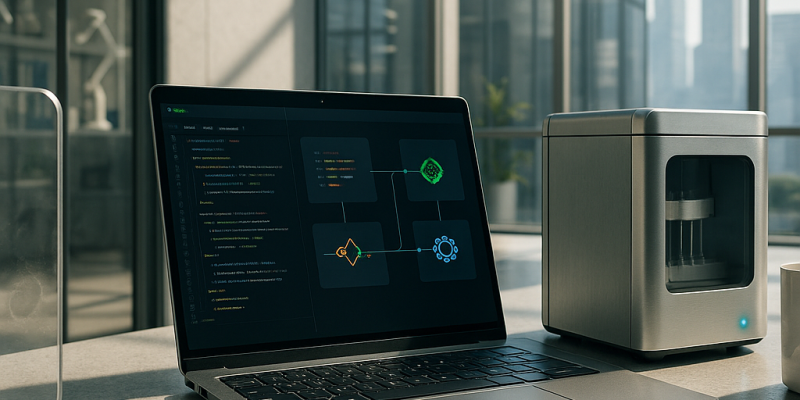
From Models to Systems: How AI Agents Are Rewriting Enterprise Workflows
Published Jan 4, 2026
If you've tired of flashy demos that never reach production, listen up: between Dec 22, 2025 and Jan 3, 2026 frontline vendors moved from “chat” to programmable, agentic systems—here’s what you need to know. OpenAI, Google (Gemini/Vertex) and Anthropic pushed multi-step, tool-calling agents and persistent threads; multimodal agents (OpenAI vision+audio) and observability vendors (Datadog, New Relic) tied agents to traces and dashboards. On-device shifted too: Qualcomm previews and CES 2026 coverage note NPUs running multi‐billion models at 500 hospitals). The takeaway: prioritize how models plug into your APIs, security, observability and feedback loops—not just model choice.

AI Becomes Infrastructure: On-Device Agents, Platform Copilots, Drug Pipelines
Published Jan 4, 2026
Over 60% of developers now use AI tools — and in the last two weeks AI stopped being a novelty and started becoming infrastructure. Here’s what you need: who did what, when, and why it matters for your products and operations. Microsoft launched Phi‐4 (Phi‐4‐mini and Phi‐4‐multimodal) on 2024‐12‐18 for Azure and on‐device via ONNX/Windows AI Studio; Apple (2024‐12‐19) showed ways to run tens‐of‐billions‐parameter models on iPhones using flash and quantization; Meta updated Llama Guard 3 on 2024‐12‐20 for multimodal safety. Platform moves — GitHub Copilot Workspace (preview) 2024‐12‐16, Backstage adoption (12‐20), HashiCorp AI in Terraform (12‐19) — embed agents into developer stacks. Pharma deals (Absci/AZ 12‐17, Generate/Amgen 12‐19), market surveillance rollouts (Nasdaq, BIS), and quantum roadmaps all point to AI as core infrastructure. Short term: prioritize wiring models into your systems — data plumbing, evaluation, observability, and governance.

AI Moves Into Production: Agents, Multimodal Tools, and Regulated Workflows
Published Jan 4, 2026
Struggling to balance speed, cost and risk in production AI? Between Dec 20, 2024 and Jan 2, 2025, vendors pushed hard on deployable, controllable AI and domain integrations—OpenAI’s o3 (Dec 20) made “thinking time” a tunable control for deep reasoning; IDEs and CI tools (GitHub, JetBrains, Continue.dev, Cursor) shipped multimodal, multi-file coding assistants; quantum vendors framed progress around logical qubits; biotech groups moved molecule design into reproducible pipelines; imaging AI saw regulatory deployments; finance focused AI on surveillance and research co-pilots; and security stacks pushed memory-safe languages and SBOMs. Why it matters: you’ll face new cost models (per-second + per-token), SLO and safety decisions, governance needs, interoperability and audit requirements, and shifts from model work to pipeline and data engineering. Immediate actions: set deliberation policies, treat assistants as production services with observability and access controls, and track standardization/benchmarks (TDC, regulatory evidence).